
Decision Board
The day's read for each pair, withheld rather than shown when the evidence behind it is too thin to support a directional view.
FX macro research
MacroMatrixFX organises rates, policy, growth, inflation, positioning, risk and price structure into a transparent research view for 10 major currency pairs — and lets you open every score to see exactly what produced it.
Educational market research only. Not financial advice.

Coverage
These ten carry the overwhelming majority of global FX turnover, and between them cover every G10 currency that has a liquid, well-documented macro story behind it. Depth matters more than breadth here: a pair is only included when the underlying data supports scoring it properly, every trading day, without gaps that would have to be papered over.
MacroDesk
Beyond the pair list sits MacroDesk — a set of boards that answer the questions a macro trader actually asks each morning, before looking at any single pair.
The day's read for each pair, withheld rather than shown when the evidence behind it is too thin to support a directional view.
What is scheduled, what has just landed, and which currencies each item touches — so the calendar is read as risk, not as a list of times.
Where the evidence is strongest across the board, so attention goes to the pairs that actually have a case rather than the ones that moved most.
Policy expectations and rate differentials for both sides of every pair, the factor family that usually dominates a currency over a macro horizon.
Explicitly surfaces where factors disagree. Most tools hide internal conflict behind an averaged number; this one puts it on a board.
Commitment-of-traders positioning across the covered currencies, showing where the market is crowded before a catalyst arrives.
Flags when conditions are thin or a session handover is under way — context that changes how any reading should be treated.
The pairs currently clearing both a strength and a confidence bar, ranked. The shortest answer to where to look first today — and it stays empty when nothing qualifies, rather than manufacturing a pick.
A written read of the session: what changed since yesterday, which drivers moved, and what is still unresolved. The desk can be caught up on in a minute rather than reconstructed.
For an upcoming release, how the read would shift across plausible outcomes — event risk framed as branches to prepare for rather than one number to wait on.
Headline context attached to the pairs it touches, so a move that looks unexplained on the factors has somewhere to be checked before it is treated as noise.
What is fresh, what has aged and what is missing entirely. If the inputs are degraded, that is shown on the desk rather than absorbed silently.
On the board
Three of those boards in the app, unedited. Between them they answer what the whole board is doing, which currency is carrying the move, and what is currently degrading the read.


Inside the app
Three screens from the app itself, and what to read on each. Not mock-ups.


Explainable by design
Every pair carries a macro-bias score on a fixed scale. The score is never the whole answer, so it opens into the factors behind it — which pulled the reading up, which pulled it down, and how strongly each contributed.
A score built on agreeing, well-covered data is not the same as a score built on thin or conflicting evidence. Confidence is shown alongside every reading so a weak basis is visible rather than buried.
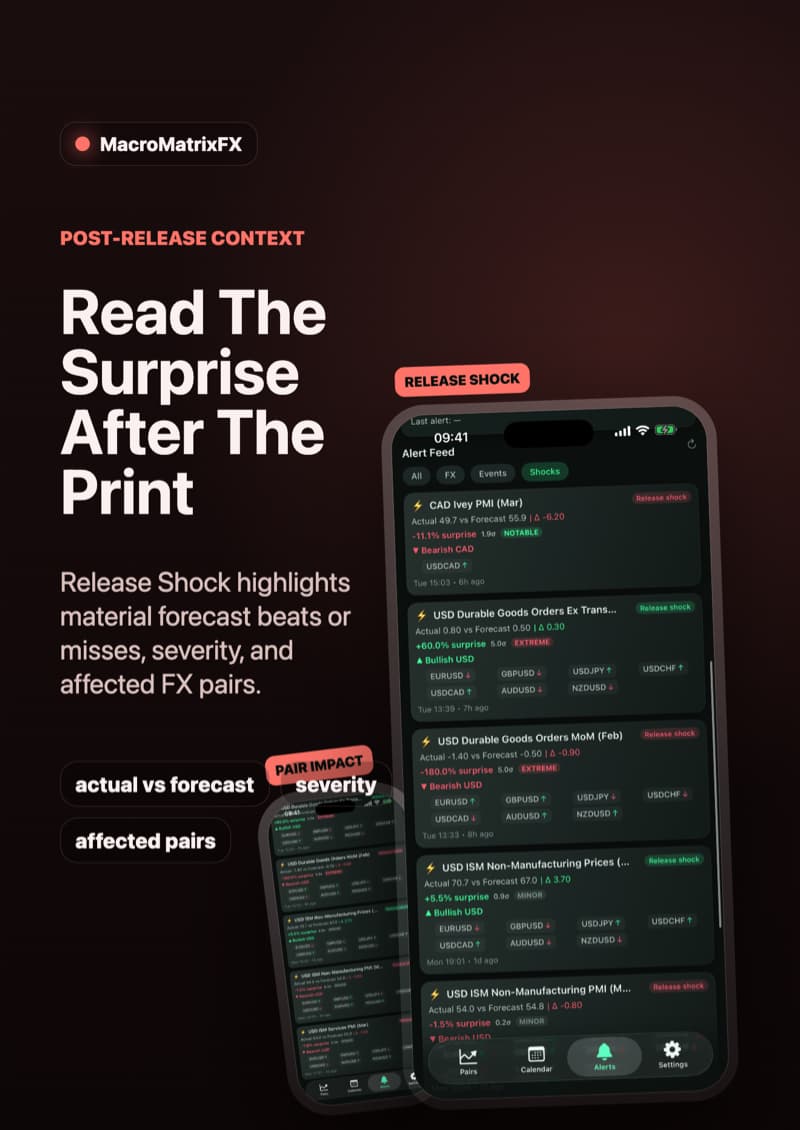
High and medium impact releases are surfaced ahead of publication, with the affected currencies identified. After the print, the surprise against forecast is measured and shown in context.
Thresholds, confidence floors, direction, quiet hours, sessions and weekend behaviour are all configurable, so notifications reflect a chosen research routine instead of a fixed default.
Inputs age at different rates. Older readings carry progressively less weight, and where a feed is stale or missing the app shows it instead of quietly filling the gap.
Pairs are not read in isolation. The prevailing market regime and confirmation from related pairs both feed the view, so a single pair's reading can be judged against the wider backdrop.
Factor families
Inputs are grouped before they are combined. Without that step, a theme measured five different ways would count five times over and quietly drown out everything else.
Policy expectations, rate differentials, real rates and the yield curve. This is usually the heaviest influence on a currency over a macro horizon, and the family where a change in expectations matters more than the level itself.
Relative economic conditions between the two economies in a pair, and how incoming data shifts that balance. A currency is always a relative trade, so these inputs are read as differentials rather than as absolute national figures.
Commitment-of-traders positioning, prevailing risk sentiment, the volatility regime and confirmation from related pairs. Crowded positioning changes how a market is likely to respond to news, independently of what the news says.
Shorter-term impulse and trend context, deliberately kept separate from the slower macro families. It is shown alongside them rather than blended in, so a fast price move never quietly overwrites a slow macro reading.
Read more in the full methodology.
Alerts
An alert that fires constantly gets muted, and a muted alert is worth nothing. The controls exist so notifications match a research routine rather than a vendor's idea of urgency.
Set the minimum strength and the minimum confidence a reading must reach before it is allowed to notify you. Weak or poorly-supported moves stay in the app instead of arriving on your phone.
Separate trigger and reset levels stop a reading that is hovering on a threshold from alerting repeatedly. A pair has to move meaningfully back before it can fire again.
Restrict alerts to chosen sessions, silence them overnight and turn them off at weekends, so delivery follows the hours you actually research in.
Around significant releases, alerts for the affected currencies are held rather than fired into the middle of a print. Only pairs containing the event currency are gated.
Methodology
The same reference that ships inside the app, summarised. Nothing here is a black box, and the app documents its own limits as carefully as its outputs.
Bias readings describe the current balance of macro evidence. They are not forecasts, targets or recommendations, and they carry no implied probability of any outcome. Read the full methodology.
Tiers
Start on the free tier with three pairs and the full economic calendar. Paid tiers add the remaining seven pairs, background alerts and progressively more control over how and when you are notified.
Compare every tierQuestions
No. There is no broker connection, no order routing and no access to trading accounts. It is a research tool that organises data — every decision and execution stays with the user, elsewhere.
The balance of macro evidence for a pair at a point in time, expressed on a fixed scale so readings stay comparable between pairs and across days. It describes the current weight of evidence. It is not a forecast, a target or a recommendation.
How much the underlying factors agree, and how complete and current the data behind them is. A strong score with low confidence means the evidence is conflicting or thin — which is itself useful information, and the reason confidence is shown next to every reading rather than hidden.
Ten majors and major crosses: EURUSD, GBPUSD, USDJPY, USDCHF, USDCAD, AUDUSD, NZDUSD, EURJPY, GBPJPY, EURGBP. The free tier includes three of them; paid tiers include all ten.
Through the trading week on a scheduled cadence, with additional recalculation around significant economic releases. Each reading carries its own timestamp so the age of what is on screen is always visible.
Yes, on paid tiers. Alerts are evaluated in the background and delivered as push notifications, subject to the thresholds, schedule and quiet hours configured in the app.
No. MacroMatrixFX provides general informational and educational market research. It is not financial, investment, tax or legal advice, and nothing in it is a personalised recommendation.
MacroMatrixFX