



Products

Research systems built around explainability.

Both apps combine macroeconomic data, market structure and event context without executing trades or replacing the user's judgement.

Which one

Same method.
Different market.

The choice is about scope, not sophistication. Take MacroMatrixFX if currencies are what you research — it is built specifically around the factors that move FX, and covers pairs rather than single instruments. Take MacroVolt if you work across commodities, equity indices and metals, and want a global regime layer sitting above everything. They share a scoring philosophy and a methodology, and neither is a cut-down version of the other.

MacroMatrixFXFX macro research

01 / CURRENCIES

Ten major currency pairs, one structured workflow.

Pair-level bias scores with transparent factor breakdowns, confidence context, economic event coverage, post-release surprise analysis and alerts you can gate on strength, confidence, direction and time of day.

  • Scores that open into the evidence behind them
  • Confidence shown next to every reading
  • Event gating around high-impact releases
  • Free tier covering three pairs and the full calendar
MacroMatrixFX in detail
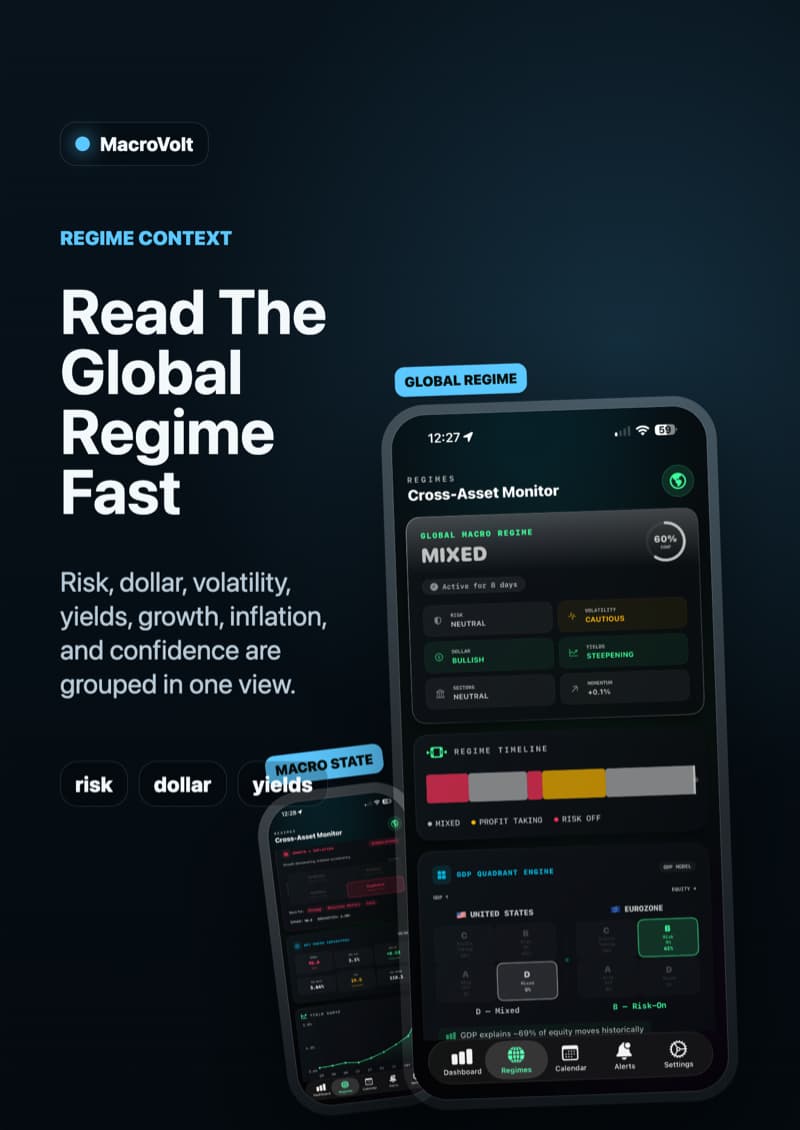
MacroVoltCross-asset macro research

02 / CROSS-ASSET

Twenty-one markets through one macro lens.

A global regime layer over cross-asset scores, with factor attribution, score history, correlation research, positioning data, economic events, watchlists and heatmaps in a single workflow.

  • Precious metals, energy, equity indices and industrial metals
  • Seven-input regime state, established before any instrument
  • Score history from 7 days up to a full year
  • Correlation view for separating regime moves from single-market moves
MacroVolt in detail

Where this fits

What we are not competing with.

Most people arrive already using something. It is worth being direct about what each of those does well, and where these apps are genuinely different.

01

Free calendars and data portals

Excellent at telling you what was released and when, and you should keep using one. What they do not do is take a position on what the release means for a specific market, weigh it against everything else in play, or tell you when the balance of evidence has actually shifted.

02

Signal services

These hand you an instruction — entry, exit, direction — and their track record is the product. We do the opposite: no entries, no exits, no win rate. You get the evidence and the conflicts, and the decision stays yours. If you want to be told what to trade, this is the wrong tool and we would rather say so up front.

03

Institutional macro subscriptions

Genuinely strong research, and considerably more expensive. But it arrives as a note or a webcast on somebody else's schedule, it is desktop-first, and it stops at the macro level. It will not wake your phone when one pair you follow crosses a threshold you set.

04

Where these sit

Instrument-level rather than thematic, explainable rather than asserted, and on the device you actually check. The gap we are filling is between a calendar that reports and a research desk that concludes — evidence organised per market, with the reasoning left attached.

Next

Compare the tiers, or read the method.