
Research guide · MacroMatrixFX
What is a fundamental bias in forex and gold?
A fundamental bias is a directional lean drawn from economic evidence (interest rates, inflation, growth, positioning) rather than from the chart. It describes where the balance of evidence sits and how firmly. It is not an entry, a target or a forecast, and a useful one always says how much evidence stands behind it.
What does bias mean in forex trading?
In forex and other markets, a fundamental bias is a view on which way the economic evidence leans for a market: bullish, bearish or neutral, usually with a measure of strength. It summarises inputs that move slowly and publish on a schedule, such as policy decisions, inflation and jobs releases, and positioning reports.
It is not the psychology term. "Fundamental attribution bias" is a thinking error, and searches for the phrase mix the two. In markets the word bias simply means a lean, and a lean is a starting point for research, not an instruction to act.
Why is a currency bias always relative?
A currency pair is the price of one currency in another, so a bias on EUR/USD has to compare two economies. Strong US data says little about EUR/USD if euro-area evidence improved by more. The same release can strengthen the dollar against one currency and leave it flat against another.
The policy-rate differential is the most common anchor for that comparison: the gap between the two central banks' rates and, more importantly, between the paths markets expect them to take. Official policy rates for many central banks are published together by the BIS.
Source: BIS: central bank policy rates.
Which evidence goes into a fundamental bias?
Most approaches group inputs into families: policy and rates; inflation; growth and activity; positioning; risk appetite; and scheduled events. What matters within each family is usually the direction of travel and the surprise against expectations, not the latest level alone.
Positioning is the family most often misread. The CFTC's Commitments of Traders report shows how futures positions are distributed across trader categories. It is published weekly and describes positions as of an earlier date, so it says how crowded a market already is, not what happens next.
Source: CFTC: Commitments of Traders reports.
How is a gold bias different from a currency bias?
Gold has no economy or central bank of its own, so its fundamental bias is read through other markets. The usual inputs are real yields (the return given up by holding a metal that pays nothing), the dollar in which gold is quoted, demand for defensive assets, and positioning.
Those inputs can disagree. Falling real yields and a firmer dollar pull in opposite directions, and a bias that hides that conflict is less useful than one that shows it. Our gold guide works through a currency-conversion example and a real factor screen.
Why does a fundamental bias work over days and weeks?
The inputs update on their own calendars: inflation and jobs data monthly, positioning weekly, and policy at scheduled meetings (the Federal Open Market Committee, for example, holds eight regularly scheduled meetings a year). Between those updates the evidence changes little, even while price moves a great deal.
That is why a fundamental bias frames context rather than timing. Much of the content searched as "daily bias" is built from price action and session levels, which is a different method. A fundamental bias that claimed to call the next hour would be claiming more than its inputs can support.
Source: Federal Reserve: meeting calendars.
What makes a bias weak or strong?
Four things separate a firm lean from a fragile one: agreement (do the families point the same way?), coverage (how much of the expected evidence is present?), freshness (how old is each input?) and stability (has the reading held across updates?). A large number built on one input is weaker than a modest number built on several that agree.
A tilt can exist without a qualified bias. When the evidence leans one way but coverage is thin or an input is stale, the honest output is a neutral reading with the tilt shown beside it, rather than a direction presented with more confidence than the evidence supports.
How MacroMatrixFX and MacroVolt express a bias
MacroMatrixFX scores each of 10 major FX pairs on one fixed −5 to +5 scale, with a confidence reading beside every score. The published bias leaves neutral only when the smoothed score and its confidence clear entry thresholds, and returns to neutral only below lower exit thresholds, so it does not flicker; until then the factor tilt stays visible beside a neutral bias. The strongest readings face a stricter bar: an absolute score of at least 3, with high confidence and agreeing evidence. Bias history is captured every four hours UTC while the market is open.
MacroVolt applies the same idea to gold, oil, metals and equity indices, read against the wider regime first. Its scores are smoothed with a 3.5-day half-life, and a bias is marked as forming before it is confirmed. Neither app gives entries, exits or targets.
An illustrative EUR/USD evidence table
Illustrative example only. These readings are invented to show the method; they are not app output and do not describe any real date.
| Evidence family | Euro area vs United States | Relative lean |
|---|---|---|
| Policy-rate path | Euro-area cuts expected sooner | Leans against EUR |
| Inflation trend | Both easing at a similar pace | No clear lean |
| Growth surprises | Euro-area releases beating forecasts | Leans towards EUR |
| Positioning (COT) | Speculative longs in EUR already large | Crowded; adds caution |
| Scheduled events | US jobs report due in two days | Hold the reading until after the release |
The families disagree, one input is about to change and positioning is crowded. The honest summary is a weak or neutral lean with the conflict recorded, not a direction. Write down what would change it: for example, the policy-path difference narrowing.
See the distinction in the app
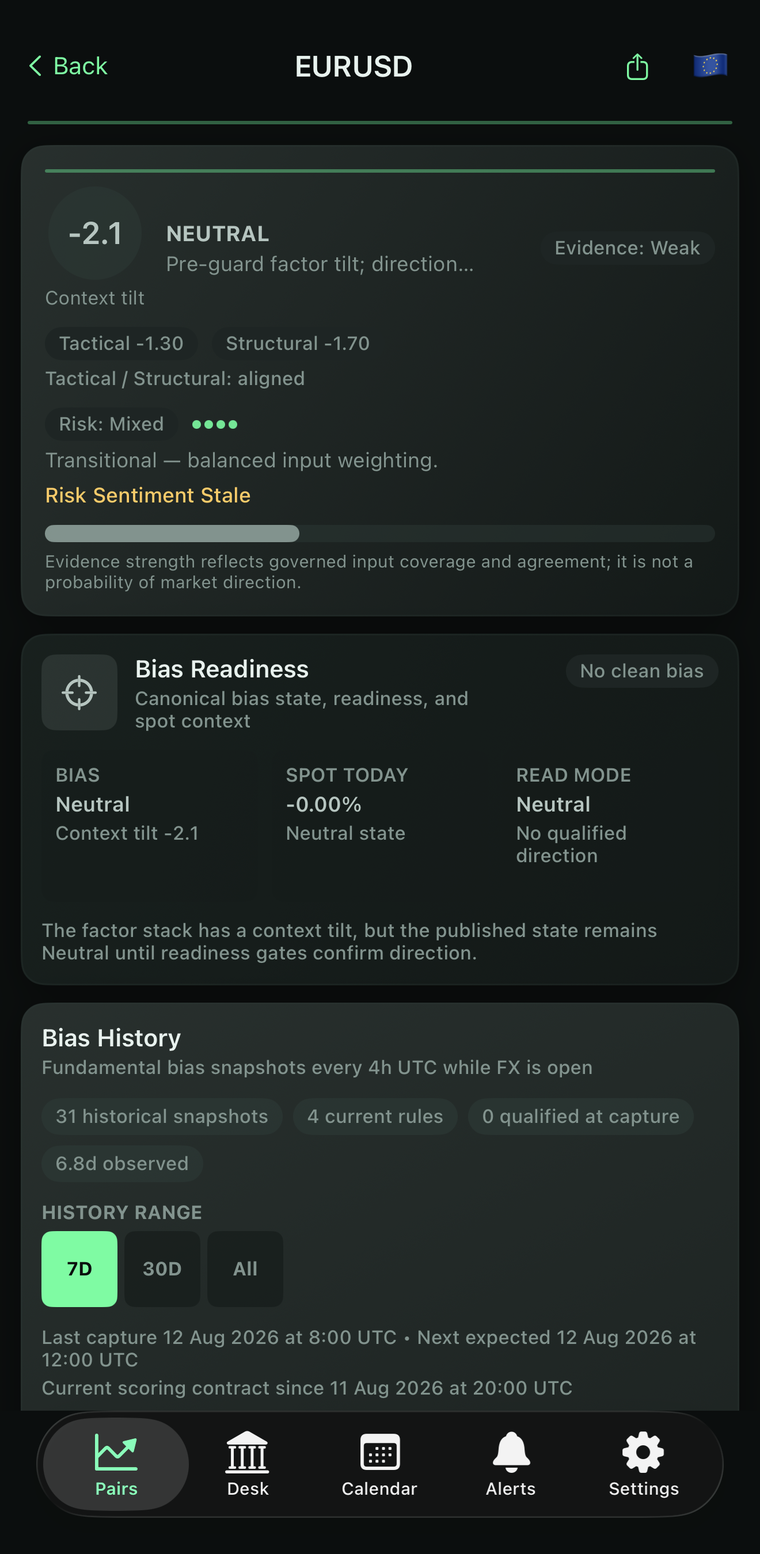
Read a live bias in the apps
Both apps are free to start, with no card and no time limit. MacroMatrixFX's free plan covers EUR/USD, GBP/USD and USD/JPY plus the economic calendar; MacroVolt's covers five markets with their top factors, the calendar and the regime overview. Every reading opens into the evidence behind it.
MacroMatrixFX
A practical reading checklist
- Name both sides: for a pair, compare the two economies, not one.
- Group the evidence by family and note the direction of travel in each.
- Record the age of every input and any release due before the next update.
- Write down where the families disagree instead of averaging the conflict away.
- State what would change the lean, and treat the result as context, not a trade.
Continue your research
- How to read a MacroMatrixFX pair analysis
- Gold and real yields: how interest rates and the dollar relate
- How to read an economic calendar
- Free market evidence checklist
- How we score fundamental bias
Explore MacroMatrixFX and its current access options. The product page explains available features and plans; check your store for current platform availability and terms.
Educational content only. The app examples are supplied by Macro Research Technologies, the developer. Historical screens explain a display; illustrative examples explain a concept. Neither establishes future price direction or investment returns. Contact us with corrections.