
Guide · Economic data
How to read an economic calendar: previous, forecast and actual
An economic calendar lists scheduled releases of official data: inflation, jobs, retail sales, GDP and central bank decisions. Each row usually carries three numbers: previous, forecast and actual. Reading them correctly takes a minute to learn. Reading them carefully takes more, because each number carries caveats that calendars rarely show.
This guide explains what each column means, why the "previous" figure can change, how to handle release times across time zones, and what a "surprise" can and cannot tell you. It also lists the major releases due this week in your own time, from each publisher's official schedule.
The three numbers
| Column | What it is | Where it comes from |
|---|---|---|
| Previous | The figure for the prior period, as currently published | The official statistics agency, for example the ONS in the UK or the BLS in the US |
| Forecast (often "consensus") | A typical expectation for the new figure before release, usually the median of a survey of economists | Compiled by news and data services before the release |
| Actual | The newly published figure | The official agency, at the scheduled time |
The calendar's consensus forecast is distinct from the official actual figure and is usually compiled from surveyed economists. Different calendars can show slightly different consensus values for the same release.
Why "previous" can change: revisions
Many statistics are first published as estimates, then revised as more complete information arrives. A calendar's "previous" column may show the revised value rather than the one first published, so it can differ from what you remember.
US payrolls are a good illustration. Each monthly Employment Situation release revises the two prior months as more business and government reports come in and seasonal factors are recalculated. In the release of 2 October 2026, for example, the BLS revised July's payroll change from +21,000 to −10,000 and August's from +162,000 to +133,000 (BLS Employment Situation, 2 October 2026).
- A large revision to the previous figure can matter as much as the new headline. Read both.
- When comparing actual with forecast, check whether the forecast was made against the old or the revised previous figure.
Release times in UK and New York time: NFP, CPI and rate decisions
Official releases come out at fixed, published times, often to the minute. The ONS has published market-sensitive statistics at 07:00 UK time since March 2020 and is currently consulting on whether to keep this (see ONS: publication times for market-sensitive statistics). Here is when the main publishers release, in their own time and in UK and New York time:
| Publisher | Official time | UK time | New York time |
|---|---|---|---|
| ONS (UK) Inflation, jobs, GDP, retail sales | 07:00 UK time | 07:00 | 02:00 |
| Eurostat (euro area) Flash inflation, GDP, unemployment | 11:00 Luxembourg time (CET) | 10:00 | 05:00 |
| BLS (US) Jobs report (non-farm payrolls, NFP), consumer prices (CPI) | 08:30 New York time (ET) | 13:30 | 08:30 |
| Census Bureau (US) Retail sales | 08:30 New York time (ET) | 13:30 | 08:30 |
| BEA (US) GDP, personal income and spending (PCE prices) | 08:30 New York time (ET) | 13:30 | 08:30 |
| Bank of England Bank Rate decision | 12:00 UK time | 12:00 | 07:00 |
| European Central Bank Rate decision | 14:15 Frankfurt time (CET) | 13:15 | 08:15 |
| Federal Reserve FOMC rate decision | 14:00 Washington time (ET) | 19:00 | 14:00 |
| Bank of Canada Rate decision | 09:45 Ottawa time (ET) | 14:45 | 09:45 |
| Reserve Bank of Australia Cash rate decision | 14:30 Sydney time | 03:30 in January, 05:30 in July | 22:30 (day before) in January, 00:30 in July |
The Bank of Japan announces when its meeting ends, with no fixed time, so it is not in this table. We list only times confirmed on each publisher's own site.
In UK terms, for most of the year: the US jobs report (non-farm payrolls, NFP), CPI, retail sales and GDP come out at 13:30; Federal Reserve decisions at 19:00; European Central Bank decisions at 13:15; and Bank of England decisions at 12:00. In the weeks when UK and US daylight saving is out of step, the US times move an hour earlier in the UK (12:30 and 18:00). The release dates and times in UK time page lists every major release with its upcoming dates.
The daylight-saving trap: the UK and US change their clocks on different dates. The US moves on the second Sunday of March and the first Sunday of November; the UK on the last Sundays of March and October. For a few weeks each spring and autumn, the usual 5-hour gap between London and New York becomes 4 hours, so a US 8:30 a.m. release lands at 12:30 London time rather than 13:30. A good calendar converts every time to your own time zone automatically; check that yours does.
Release dates can move. Agencies occasionally reschedule (the BLS moved several 2025–26 releases after funding lapses), so confirm dates against the agency's own calendar close to the event.
This week's forex news calendar: major releases in your time
The box below picks out the widely watched official releases and rate decisions due in the next seven days and shows them in your time zone. It uses the list that follows, which is taken from each publisher's own schedule (checked 28 October 2026). It is a short list of major releases, not a full calendar.
Major releases in the next 7 days, in your time
A selection of widely watched official releases and rate decisions, taken from each publisher's own schedule. Dates can move, so confirm with the publisher close to the day.
Scheduled major releases, late October to December 2026
| UK date and time | New York time | Release | Publisher |
|---|---|---|---|
| Thu 29 Oct, 12:30 | 08:30 | GDP advance estimate (Q3), and personal income and spending with PCE prices, September US | BEA |
| Thu 29 Oct, 13:15 | 09:15 | European Central Bank rate decision Euro area | ECB |
| Fri 30 Oct, 10:00 | 06:00 | Preliminary flash GDP estimate (Q3) and unemployment Euro area | Eurostat |
| Tue 3 Nov, 03:30 | Mon 2 Nov, 22:30 | Reserve Bank of Australia rate decision Australia | RBA |
| Wed 4 Nov, 10:00 | 05:00 | Flash inflation estimate, October Euro area | Eurostat |
| Thu 5 Nov, 12:00 | 07:00 | Bank of England rate decision UK | Bank of England |
| Fri 6 Nov, 13:30 | 08:30 | Employment Situation (jobs report, NFP), October US | BLS |
| Tue 10 Nov, 13:30 | 08:30 | Consumer Price Index, October US | BLS |
| Thu 12 Nov, 07:00 | 02:00 | GDP first quarterly estimate (Q3) and monthly GDP, September UK | ONS |
| Fri 13 Nov, 10:00 | 05:00 | GDP and employment flash estimate, Q3 Euro area | Eurostat |
| Tue 17 Nov, 07:00 | 02:00 | Labour market: employment, unemployment and pay UK | ONS |
| Tue 17 Nov, 13:30 | 08:30 | Retail sales, October (advance) US | Census Bureau |
| Wed 18 Nov, 07:00 | 02:00 | Consumer price inflation, October UK | ONS |
| Fri 20 Nov, 07:00 | 02:00 | Retail sales, October UK | ONS |
| Wed 25 Nov, 13:30 | 08:30 | GDP second estimate (Q3), and personal income and spending with PCE prices, October US | BEA |
| Tue 1 Dec, 10:00 | 05:00 | Flash inflation estimate, November Euro area | Eurostat |
| Fri 4 Dec, 13:30 | 08:30 | Employment Situation (jobs report, NFP), November US | BLS |
| Tue 8 Dec, 03:30 | Mon 7 Dec, 22:30 | Reserve Bank of Australia rate decision Australia | RBA |
| Wed 9 Dec, 14:45 | 09:45 | Bank of Canada rate decision Canada | Bank of Canada |
| Wed 9 Dec, 19:00 | 14:00 | Federal Reserve (FOMC) rate decision US | Federal Reserve |
| Thu 10 Dec, 13:30 | 08:30 | Consumer Price Index, November US | BLS |
| Fri 11 Dec, 07:00 | 02:00 | Monthly GDP, October UK | ONS |
| Tue 15 Dec, 07:00 | 02:00 | Labour market: employment, unemployment and pay UK | ONS |
| Wed 16 Dec, 07:00 | 02:00 | Consumer price inflation, November UK | ONS |
| Wed 16 Dec, 13:30 | 08:30 | Retail sales, November (advance) US | Census Bureau |
| Thu 17 Dec, 12:00 | 07:00 | Bank of England rate decision UK | Bank of England |
| Thu 17 Dec, 13:15 | 08:15 | European Central Bank rate decision Euro area | ECB |
| Fri 18 Dec, 07:00 | 02:00 | Retail sales, November UK | ONS |
| Wed 23 Dec, 13:30 | 08:30 | GDP third estimate (Q3), and personal income and spending with PCE prices, November US | BEA |
US releases at 08:30 New York time land at 13:30 UK time, except on 29 October: that week the UK has changed its clocks and the US has not, so they land an hour earlier, at 12:30. Eurostat's 11:00 releases land at 10:00 UK time.
Impact ratings
Most calendars tag events as high, medium or low impact. These ratings are the calendar provider's judgement of how closely markets usually watch a release. They are not an official classification and not a prediction. Treat them as a filter for what to pay attention to.
What a "surprise" is, and what it isn't
A surprise is simply actual minus forecast. The same surprise can be expressed in three quite different ways, and it helps to know which one you're looking at. Take actual 0.5% against a forecast of −0.2%:
- Absolute difference: 0.5 − (−0.2) = 0.7 percentage points, in the release's own units. This is the plainest measure.
- Percentage of the forecast: 0.7 ÷ |−0.2| = 350%. This is the miss relative to the size of the forecast. It is not the growth rate of retail sales and not a probability, and it becomes very large whenever the forecast is close to zero.
- A scaled score (shown as "σ" in some tools): the difference divided by a reference size, so that different releases can be compared on one scale. What it means depends entirely on how that reference size is chosen; see the note on our apps below.

What a surprise does not tell you:
- It isn't a direction for any market. The same surprise can be followed by different moves depending on what was already expected, other data released at the same time, revisions and the wider backdrop.
- The headline isn't the whole release. Details, components and revisions can point the other way.
- Consensus figures vary by source, so the size of a surprise can differ between calendars.
- Past patterns don't guarantee future ones.
How our apps organise this information
Our apps are research tools. They don't place trades and don't tell you what to do.
- MacroMatrixFX (currencies) includes an economic calendar with previous, forecast and actual values on its free plan. Paid plans add reminders before scheduled events: high-impact events with a one-hour lead on Starter, and high- and medium-impact events with a choice of lead times on Pro.
- MacroVolt (metals, energy and indices) includes an economic calendar that can be filtered by impact and category, so it narrows to the releases relevant to the markets you follow.
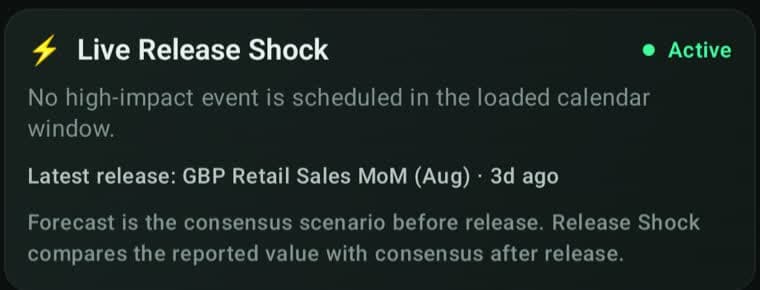
- Release Shock (MacroMatrixFX Pro, MacroVolt Ultimate) compares each new actual with its pre-release consensus. In the app's words: "Forecast is the consensus scenario before release. Release Shock compares the reported value with consensus after release."
- How its "σ" score works: it is a scaled score, not a standard deviation measured from each release's own history. The difference is divided by the larger of |forecast| and 1, then by a fixed reference size set for that category of release, and the result is capped at 5. It is a consistent way to rank how large a miss is across releases; it isn't a probability, and it doesn't say what any market will do.
Follow the calendar in MacroMatrixFX
The full economic calendar is on MacroMatrixFX's free plan: high- and medium-impact releases shown in your local time with previous, forecast and actual, and each release tagged to the currencies it affects. Paid plans add reminders before events and Release Shock after them.

Explore MacroMatrixFX · Compare plans · For metals, energy and indices, see MacroVolt
A short checklist for reading any release
Use the free economic-release worksheet to record the figures, revisions and source times together.
- Check the time in your own time zone, especially around clock changes.
- Note the forecast and where it came from.
- When the figure lands, compare actual with forecast, and check whether previous was revised.
- Read beyond the headline: components, revisions and the agency's own commentary.
- Remember that context matters. A surprise describes the data, not what any market will do next.
Sources
- Office for National Statistics: Changes to publication times for market-sensitive statistics; release calendar
- U.S. Bureau of Labor Statistics: Employment Situation news release, 2 October 2026; Employment Situation release schedule
- Eurostat: Euro indicators release calendar
- U.S. Bureau of Labor Statistics: Consumer Price Index release schedule; U.S. Census Bureau: retail sales release schedule; U.S. Bureau of Economic Analysis: release schedule
- Central banks: Federal Reserve, ECB (announcement time), Bank of England, Bank of Canada and Reserve Bank of Australia meeting calendars
Sources are cited so you can verify them. They are independent of Macro Research Technologies and have not reviewed or approved this content. Educational content only, not financial advice.