
Reference · Currency pairs
EUR/USD fundamentals: rates, inflation and the next releases
EUR/USD at a glance
- Policy rates
- ECB 2.50% · Fed 3.75–4.00%
- Rate gap (EUR − USD)
- −1.50 to −1.25 pp
- Real-rate gap
- −1.80 to −1.55 pp
- Inflation
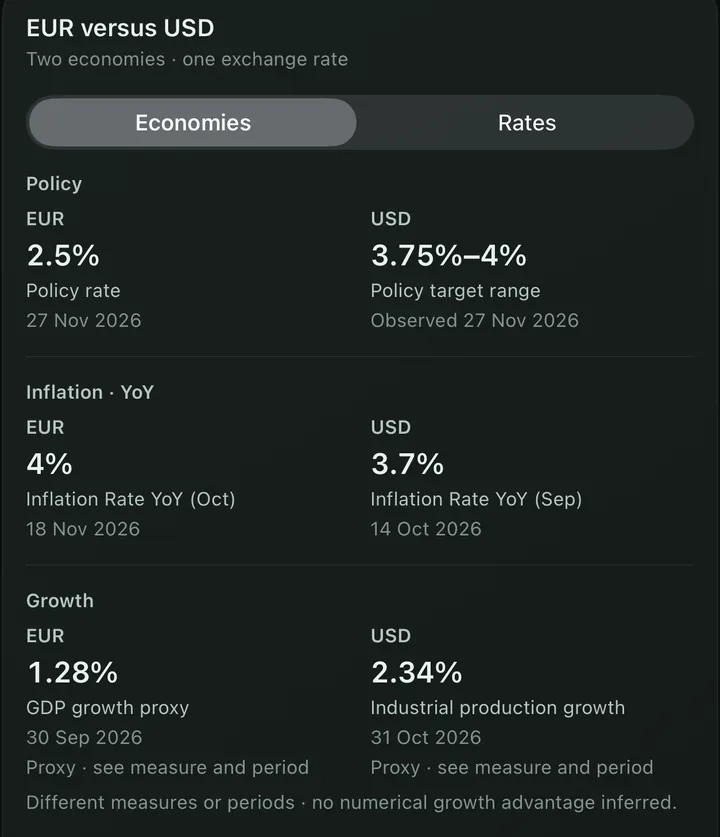
- EUR 4.0% (Oct 2026) · USD 3.7% (Sep 2026)
- Next decision
- Fed · Wed 9 Dec 2026, 19:00 UK
- Next release
- Euro-area flash inflation · Tue 1 Dec 2026, 10:00 UK
EUR/USD is the price of one euro in US dollars, and the most traded currency pair. Its fundamentals come down to two central banks, the European Central Bank and the Federal Reserve, and the figures each one watches: inflation, jobs and spending. This page keeps the official numbers for both sides in one place and lists the next dates that can change them.
The next EUR/USD releases and decisions in your time
Interest rate differential: ECB versus Fed
The European Central Bank's deposit facility rate is 2.50% and the Federal Reserve's federal funds target range is 3.75–4.00%, so the gap between the two policy rates is −1.50 to −1.25 pp in USD's favour. After each side's latest annual inflation, the real-rate gap is −1.80 to −1.55 pp (real rates: EUR −1.50%, USD +0.05% to +0.30%).
A gap between policy rates is not a broker's swap rate and says nothing about where either rate goes next. Pairs tend to move when the expected path of one rate changes against the other, which is why the next decisions and the data before them matter more than today's gap. All ten pairs are compared in the central bank rates table; meeting dates are on the ECB and Fed pages.
Inflation on both sides
| Currency | Annual inflation | Period | Measure | Published by |
|---|---|---|---|---|
| EUR | 4.0% | Oct 2026 | HICP, all items | Eurostat |
| USD | 3.7% | Sep 2026 | CPI-U, all items | US Bureau of Labor Statistics |
The BLS could not publish an October 2026 annual rate because October 2025 prices were not collected.
Positioning: the weekly CFTC report
In the Commodity Futures Trading Commission's report for 17 November 2026, large speculators were net short 142,710 euro futures contracts, 16.5% of open interest, down 6,314 on the week. Over the past three years, 2% of weekly readings were at or below this level, so it is close to the most short of that period.
Positioning describes what futures traders already hold, not what they will do next; an extreme can unwind sharply or persist for months. The CFTC also publishes a Traders in Financial Futures report, which splits the same contracts into dealers, asset managers and leveraged funds. Those groups can sit on opposite sides, so a figure taken from that report, such as the positioning view in MacroMatrixFX, can differ from the one here. Every currency is on this week's COT positioning, and how to read the COT report explains the columns.
Releases and decisions that move EUR/USD
The next scheduled dates for both economies, from each publisher's own calendar. Each links to its full list of dates.
| Date | Release or decision | UK time | New York time |
|---|---|---|---|
| Tue 1 Dec 2026 | Euro-area flash inflation | 10:00 | 05:00 |
| Fri 4 Dec 2026 | US jobs report (NFP) | 13:30 | 08:30 |
| Wed 9 Dec 2026 | Fed rate decision | 19:00 | 14:00 |
| Thu 10 Dec 2026 | US CPI | 13:30 | 08:30 |
| Wed 16 Dec 2026 | US retail sales | 13:30 | 08:30 |
| Thu 17 Dec 2026 | ECB rate decision | 13:15 | 08:15 |
| Wed 23 Dec 2026 | US PCE inflation | 13:30 | 08:30 |
| Wed 6 Jan 2027 | Euro-area flash inflation | 10:00 | 05:00 |
| Fri 8 Jan 2027 | US jobs report (NFP) | 13:30 | 08:30 |
| Wed 13 Jan 2027 | US CPI | 13:30 | 08:30 |
What moves EUR/USD
Three things carry most of the weight. First, the expected path of both policy rates: a Fed that is expected to cut sooner, or an ECB expected to hold longer, narrows the dollar's rate advantage. Second, the data that shapes those expectations: US inflation, the jobs report and spending on one side, euro-area flash inflation and growth on the other. Third, demand for dollars as a safe asset when markets are stressed, which can outweigh rate gaps for a while.
The pair often moves on the surprise rather than the number: a release that matches what was expected can leave it unchanged. How to read an economic calendar explains previous, forecast and actual, and the US CPI page walks through the October 2026 release.
The ECB and the Fed: what each targets
Both aim for 2% inflation, measured differently: the ECB on the euro area's harmonised index of consumer prices (HICP), the Fed on the price index for personal consumption expenditures (PCE), which comes out later than US CPI. The Fed also has a maximum-employment goal, which is why the US jobs report matters as much as inflation for EUR/USD. See the ECB meeting dates and FOMC meeting dates in UK, US and your own time.
How MacroMatrixFX weighs EUR/USD
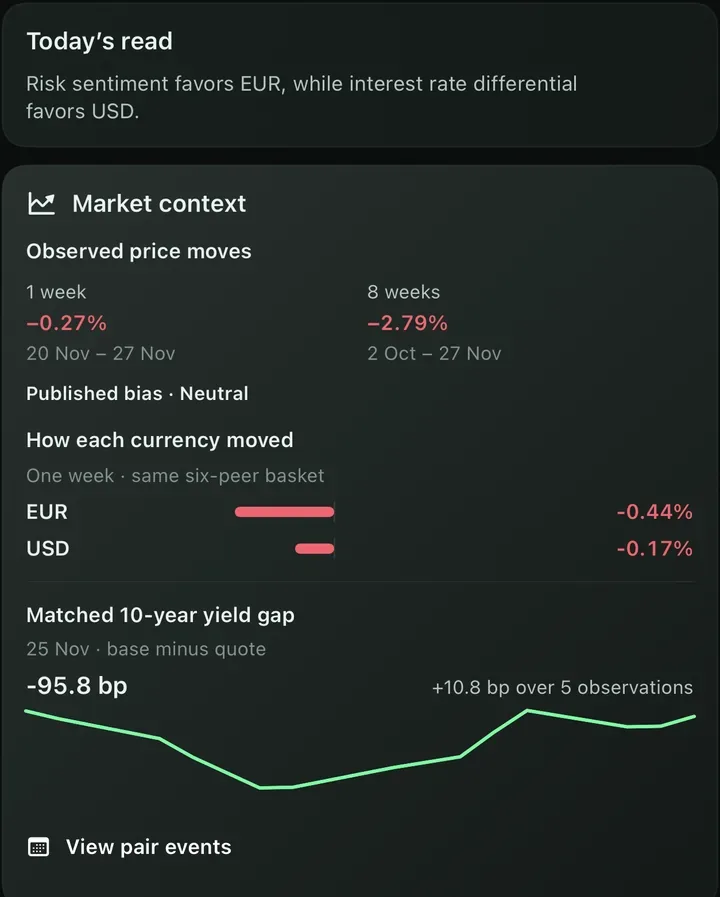
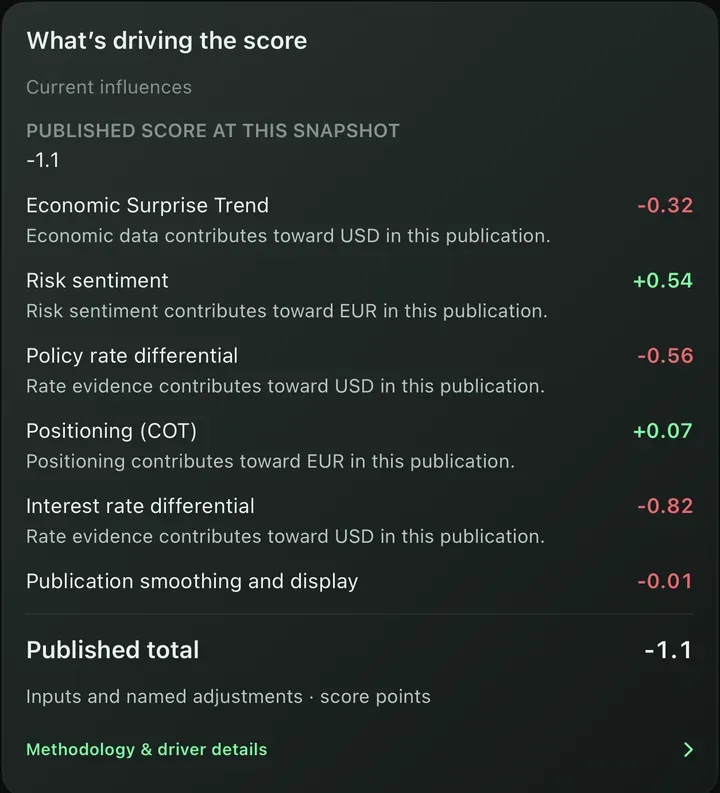
MacroMatrixFX combines inputs like these with others, such as risk sentiment and recent data surprises, into one published reading per pair and shows how much each one contributes. EUR/USD is on the free plan, with the full economic calendar; the breakdown and the two-economies view below come with Starter and Pro. The screenshots are a dated example, not a current reading.
Explore MacroMatrixFX · Compare plans · How the reading is built
EUR/USD questions people ask
What is the EUR/USD interest rate differential?
ECB 2.50% minus Fed 3.75–4.00%: a gap of −1.50 to −1.25 pp (policy rates as of 28 November 2026). USD carries the higher policy rate. Taking off each economy's latest inflation, the real-rate gap is −1.80 to −1.55 pp.
When are the next ECB and Fed decisions?
Fed: Wednesday, 9 December 2026, 19:00 UK time (14:00 New York); ECB: Thursday, 17 December 2026, 13:15 UK time (08:15 New York).
Which releases move EUR/USD?
Mostly the ones that change what markets expect from the ECB and the Fed: inflation, jobs and spending figures, and the decisions themselves. The next one listed here is Euro-area flash inflation on Tuesday, 1 December 2026 at 10:00 UK time.
Why is US inflation shown for September?
The US Bureau of Labor Statistics could not publish an annual inflation rate for October 2026, because October 2025 prices were never collected during the 2025 funding lapse. September is the latest annual rate; the monthly October change was published on 10 November.
Is there a free EUR/USD fundamentals app?
Yes. EUR/USD is one of the three pairs on MacroMatrixFX's free plan, together with the full economic calendar. The factor breakdown, the two-economies view and alerts come with Starter and Pro.
Other pair fundamentals: GBP/USD, USD/JPY.
Sources
- Policy rates: European Central Bank and Federal Reserve
- Inflation: Eurostat and US Bureau of Labor Statistics
- Positioning: CFTC Commitments of Traders (legacy report, futures only)
- Eurostat release calendar (euro-area flash inflation)
- Bureau of Labor Statistics release schedule (CPI, jobs report)
- BLS October 2026 CPI release (note on annual rates)
Educational content only, not financial advice. Figures come from the official sources listed and can be revised; dates can move. Contact us with corrections.